
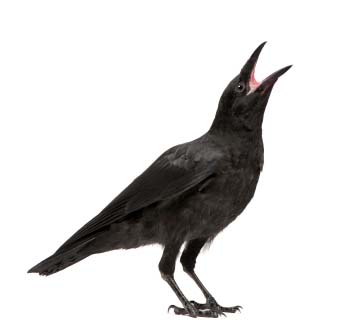
One of our neighbors has a crow’s nest in her yard and we often wake up in the morning to a symphony of cawing. A few years ago, we noticed that one of the year’s hatchlings had a rather unique voice. Instead of the clear, energetic “caw” of the regular crow, this one had a sound more like an “awww” with a pronounced nasal resonance. Like it had a bad head cold. My family immediately nicknamed this crow “the whiner” because that’s really what it sounded like compared to the other crows.
“Whiner” returns every year in the spring bringing its unique song to our block. A couple of weeks ago, Whiner was having an argument with another crow in the spruce tree in our front yard. I went out to the front porch to bawl them out and one of the crows flew off. Whiner remained in the tree.
 About an hour later, when I looked out into our backyard there was a crow sitting on the fence just above the birdbath. The crow was sitting, not standing as they always do, as if sitting on eggs on the nest. This surprised me because it didn’t seem like the safest place for a crow to be sitting, with a busy sidewalk right beside the fence. Another thing that amazed me was that the birdbath and the garden below the bath was teeming with sparrows and little yellow finches. Right underneath the crow! These birds usually avoid the crows.
I was pretty sure that this crow was “Whiner” and became concerned that it may have been injured by the other crow. After saying a prayer for healing for the crow, I went for my morning walk, walking right past the crow on the fence. Upon returning, the crow was standing, “awwing” away and the little birds were gone. It was indeed “Whiner.”
I began to ponder whining as humans usually encounter it. In babies, the sound is a sign of a need. In small children, it can turn into a request or demand. Depending on its frequency, the sound can become downright annoying.
Whining in adults is rampant – usually accompanied by numerous complaints. Most of us are either annoyed by the whining or contribute to it and have a whinefest. There are negatives and positives to whining.
On the negative side, if the frustration turns into bitterness and/or resentment, this can lead to serious consequences. Bitterness and resentment have very low frequencies and vibrations and can easily be planted in the body causing all kinds discomforts and ailments.
There is a biological component to your feelings. For every emotion you feel, your brain and hormonal system releases a surge of chemicals (neuropeptides) that floods your entire body. On the good news side, it only takes ninety seconds for this process: from whatever triggered the emotion; for the hormones to flood the body; and then to be flushed out of the bloodstream. After ninety seconds we either choose to continue the emotion or release it. This is useful information.
Used with consciousness and intention, whining can be a helpful sound to use to release frustration. Whining is one of the body’s innate ways of toning. Toning is the natural voice of the body and is used to help bring the body back into balance. Other examples are groaning, sighing, moaning, “ouch” and “ahhhh.” Next time you hurt yourself (presuming this is minor), try not saying “ouch” and it will hurt a lot more.
You can set a specific time limit (like 15 minutes for example) to consciously give voice to a frustration, release it and return to a positive frame of mind. Make sure, though, that anyone around you understands what you are doing. You can whine in the shower and watch the frustrations go down the drain. Often, when an emotional charge is dissipated, the solution appears.
So the next time a frustration comes up, give yourself ninety seconds. If you choose to hang on to it after that, make a date with yourself in the shower for some constructive whining.