
Sharon’s Introduction
Thank you to all those who emailed their experience or feelings about my blog article, “Heavy Metal Music”.
I was thrilled when Pamela emailed me with her thoughts about the article. She is a friend of mine and a colleague. I have experienced her work and her gift and she is AMAZING! So I asked her if she would continue the conversation about music based on her experience, training in sound healing and her background. I love her article and am thrilled to share it with you.
Contributed by Pamela Alexander
When I read Sharon’s recently reprinted blog about heavy metal music, it struck such a chord with me that I emailed to thank her, and she immediately invited me to contribute to the discussion in a guest blog.
I’m going to make a radical suggestion in this blog, which may fly in the face of our perceptions about “healing music”—i.e. what is, and what isn’t.
 Music is healing. Period.
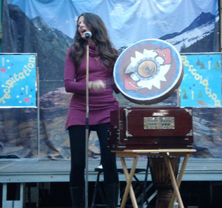
If you attended my bi-monthly Singing Circles in Calgary, you would notice that we sing simple songs and chants from many world traditions: songs that carry positive messages, are fun to sing, and build community. I choose these songs to share because I have witnessed the impact they have on my relationship with my own voice, and the impact they have on the people who attend the Circles.
However, if you sneaked into my Ipod and had a peak at my playlists, you might be surprised. You would find everything from roots/folk, jazz, house, alternative rock, classical, 70’s hard rock, bubble gum pop, alt country, R&B, hip hop, blues, musical theatre covers from the cast of Glee. . . the list goes on.
Depending on the day, my emotional state, the weather and probably a few other less nameable factors, I might be listening (and singing along, loudly) to any of the above. It’s all healing music to me.
Most of us have had the experience of being a bit tired or feeling a touch blue, and when a cheerful, upbeat song comes on the radio we perk up, and feel a little more capable of getting on with the day.
However, sometimes when we are feeling blue, the best course of action might be to pick the saddest songs we can find, and listen to them over and over.
Huh? Sounds counter-intuitive and maybe even a bit self-indulgent, I know.
The best way I can explain is by relating a concept called “musical homeopathy.” In very general terms, homeopathic medicines attempt to match the vibration of the symptoms you’re trying to change. So, in its most basic sense, the concept behind musical homeopathy is this: we can shift some of our so-called “darker” emotions by choosing the appropriate music to match our emotional or vibrational state. We do this through participating in the music, through listening to it or playing it or singing it ourselves.
So, if I was feeling sad, I might choose blues music or haunting Appalachian ballads or rock ballads about a lover leaving. If I was feeling angry about a personal relationship or the injustices in the world, it might be heavy metal or hip hop that rages against the machine. If I am filled with so much mysterious feeling it is almost overwhelming, I might choose big, instrumental music—Beethoven’s symphonies and sonatas are a go-to for me in times like that, as is the music of the Icelandic alt rock group, Sigur Rós.
What I have noticed is this: if I “hang out” with whatever music I choose to match my mood, eventually—minutes or hours or days or weeks later—the emotion shifts, and I no longer desire that music. The time of the haunting ballad is done, and now I want to dance around my living room!
The key, however, is to surrender to the necessary music for as long as is needed. That is to say, I sing or play or listen to the music without having some pre-conceived notion about what “should” happen, or when it should happen.
Musically, we can express the idea of matching mood to sounds as “modes,” or scales. In Western music, the scales known as “minor” are generally dark/sad sounding, but “major” scales are bright/happy sounding (think Twinkle, Twinkle Little Star). Part of what I offer in my voice coaching is to help people find the musical “modes” of expression that are the best medicine for where they are in life at the time.
Looked at in this way, all music has something to offer us, because all of it is generated from a particular human emotional state that we will all experience at some point or another in our lives.
From a broader perspective of wellness, musical homeopathy is simply being with what is. It’s accepting the current emotional state and cultivating awareness of it until it transforms organically, rather than trying to change it or fix it or ignore it. It’s musical self-acceptance, and as such, deeply healing.
So encourage your partner to spend Saturday afternoon with his 70’s rock (Nazareth, anyone?), and let your teenage son have his goth death metal (just wear your ear plugs, as Sharon did). Dial up that 80’s pop on your Ipod, and feel no shame. All music can be good medicine!
Pamela L. Alexander
February 10, 2013
Contact Pamela at
Facebook: http://www.facebook.com/CompassionateCommunityVoice
BIO
Pamela L. Alexander
Compassionate Community VOICE
www.compassionatevoice.ca
Pamela enjoys a life-long participation in music and vocal play through improvised sound, original songs, spoken word and world music. She is a private voice coach and facilitator of community song circles. Her approach is one of: deep listening, “there are no wrong notes” philosophy, and sharing unique practices that nurture and sustain the speaking/singing voice.