
“The purpose is to transform, not perform.”
By Nancy A. Watters
www.-luminous-tones.com
 The Yoga of Sound has been called the “alchemy of the soul”. It includes ancient sonic formulae used by Hindus for thousands of years to enhance health and deepen the spiritual dimension of life. The practices are detailed in the Vedas, the most ancient Hindu scriptures, written by Rishis (visionary seers and poets) who were tuned into the vibratory structures of the universe. The Vedas contain mystic sonic formulas called mantras, which form the basis of the Yoga of Sound the same way that postures (asanas) form the basis of Hatha Yoga practice. Hatha Yoga primarily focuses on developing the physical body and its nervous system, while the Yoga of Sound works to transform and restore the energies of the soul through channels known as nadis, — subtle channels of the chakra system (energy vortexes) related to the soul’s infrastructure. The Yoga of Sound optimizes the energy of the chakras, and helps maintain positive emotional and spiritual states of consciousness. Traditionally, toning and chanting were always paired with Hatha Yoga postures for maximum benefit.
Hindu culture was highly sophisticated, indicating refined intellect. They are credited with originating our modern number system, development of agriculture, and the invention of the wheel, for example. “What differentiates the Hindu brilliance in logic and rational thought from its Hellenistic parallel is that Hindus were very aware of the intellect’s limitations. They understood that only the feminine intuitive mind was capable of grasping the deepest spiritual truths in powerful flashes of intuition. The Rishis were expert at this process, and they left behind a gargantuan legacy of mantras to help awaken the same flashes of intuitive perception in us.”1 This body of knowledge is encoded in the Vedas, which date to between 1500 and 500 BC.
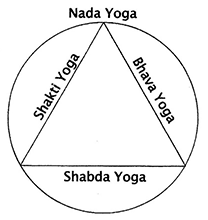
There are four main streams of sonic mysticism in Hindu tradition. Traditionally, people studied them separately, from experts who specialized in one area. Russill Paul has synthesized them into a comprehensive approach which allows us to experience a unified cross-disciplinary system—a system he calls “The Yoga of Sound”. Briefly, the four main streams are:
SHABDA YOGA (Vedic Mantras): Keys to Intuitive Knowledge
Mantras are exact and specific sonic formulae, vehicles of the spiritual realm that transport us to higher states of consciousness. They draw on the power of the Divine Word and recognize the power of our own words and thoughts as well. Mantras build a protective force-field around the soul, and help us align ourselves with the harmony of the Universe, thus creating greater harmony within and without. Saguna mantras chant the attributes of God, such as compassion, love, mercy and joy. Such mantras help us personify and strengthen those qualities of Divine Light in ourselves.
Modern sources for understanding the power of words and thoughts include quantum physics, Masaru Emoto (how words and thoughts affect water); Larry Dossey (scientific evidence for the power of prayer); John Diamond (applied kinesiology); and Louise Hay (affirmations).
SHAKTI YOGA (Tantric Mantras): Alphabets of Divine Energy
Shakti Yoga views the Universe as an interrelated web of energy, energy which is constantly being exchanged among all the parts of the universe through an intricate system of nadis (energy channels). Our bodies are a microcosm of that universe, and thus every part is considered sacred. The sounds of individual Sanskrit letters and the natural sounds we all make—grunts, groans, sighs—are basic sound structures (bijas or “seed syllables”). Shakti Yoga focuses on balancing and renewing the energy rooted in our bodies. It helps us trust the body’s innate wisdom and teaches respect for sexual energy.
BHAVA YOGA (Devotional Mantras): The Sound of Love and Sacred Relationships
Devotional chants touch the depths of the heart and soul. When one brings an attitude of devotion, reverence and love of the Divine to chant, it opens the spirit. We express our love to God, and we also receive God’s love and light. Kirtan is one style of call-and-response chanting the names and attributes of God. All faith traditions have practices of devotional singing and chanting. Sacred World Song™ is a project founded by Nancy Watters that specializes in teaching devotional chants from a wide range of world spiritual traditions.
NADA YOGA: The Science of Vibration
Shabda, Shakti and Bhava Yoga work with three levels of our being—mental/emotional; physical and spiritual. When these are in balance, health is maintained. Nada Yoga encircles them all. It includes the science of vibration, musical intervals, harmonics, entrainment, meditation and deep listening. It also includes very sophisticated use of ragas—musical modes that are used at specific times of day to create exact effects.
MODERN TEACHINGS
From the most ancient to the most modern spiritual traditions, we find a fundamental, unified core of wisdom that understands the power of sound. Most creation stories, for example, teach that the world began with the Word (sound). And science now confirms that everything in creation is made of tiny, subatomic, vibrating particles (string theory).
Chanting is described in the recent traditions as a “ladder for the soul” which kindles the spirit and unifies hearts. ‘Abdu’l-Baha describes such music saying it “will develop the spirit and produce harmony and exhilaration, unfolding the inner potentialities of life. Chanting together creates an energy field of love where we experience “unity in diversity”—the blending of many different notes into a perfect chord, and we all come fully equipped to participate.When we are so blessed, we experience our loving connection with each other and with our Creator.
1 Russill Paul, The Yoga of Sound, New World Library, 2004, p. 24. www.russillpaul.com