
Those who have studied with us, or listened to one of our presentations will certainly know this. I’m sure we mention it every time we are invited to speak to a group, and we always mention it during our own events. 
- Sound travels 4 1/2 times faster through your body than it does through the air.
- And 12 times faster through your bones than through the air.
Other than being a fascinating bit of trivia, does it matter?
Of course it does. Sound has a dramatic and an immediate impact on the body. And this is largely because the body is such a good conductor for sound. Think about that for a minute.
Electricity travels (conducts) through a copper wire and consequently imparts a dramatic change on the copper atoms. Electrons are literally ripped out of the atoms, as they travel in the direction of the electrical flow. But what of the rubber insulator surrounding the wire? Electricity has virtually no effect on the rubber, and it is only if the voltage is extremely high that an electron can be forced to break through the insulating jacket.
In order for sound, which is described as vibrational energy, to have an impact on matter, to be able to send it into a state of vibration, it must be able to travel through it. And the easier it can do that, the more it can affect it.
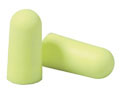 I have created a couple of simple experiments that you can do at home. All you need is a reasonably quiet room, and a set of good earplugs. Earplugs come with a Noise Reduction Rating (NRR) which is measured in dBA (decibels – ‘A’ weighted). The higher the number, the better the sound reduction. Typically these range from the low 20s to 33. I have not seen earplugs that are rated better than 33, and the reason is simple. Earplugs are inserted into your ear canal to block the sound from travelling to your eardrum. But not all of the sound takes this route. Certainly most does, but some sound travels through you, through your bones and flesh to reach the eardrum, and while the ear is designed to be sensitive to sounds that travel through the air, it can pick up sounds that travel through us. They are just heard as much quieter than sounds that travel through the air because the ear isn’t really designed to hear them. So simply blocking the ear canal will never completely block out all of the sound.
If you don’t have earplugs, and if you can’t find them locally, you can purchase a kit from us in our store containing 2 sets of earplugs with an NRR of 33. Because we encourage you to play, we are offering them at a price that just recovers our cost. And if you’re not accustomed to wearing earplugs, I’ve included instructions for inserting them at the end of the article.
Sounds travels trough your Body!
 We all brush our teeth several times a day, but try this. This works best with a new toothbrush, but it’s not necessary. First brush as you always do. Pay attention to the sound, how loud it seems, and the pitch (the frequency or how high or low the sound is) of the sound.
Then, insert the earplugs, and brush again. Do you notice a difference?
With the earplugs in, you are hearing the sound as it travels through your bones. Without the earplugs, that sound is masked by all the other sounds around you.
Listen to the sound of your Body.
 Find a quiet spot free from distractions, and a minimum of outside noise. This is often done best first thing in the morning or late in the evening when the world is quiet.
Insert the earplugs, and sit or lay down with your eyes closed. Listen to the sounds your body makes.
Focus your attention on your heartbeat, and listen carefully. You can often hear not only your heartbeat, but also the sound of the blood pumping through your arteries.
Now slide your focus around your body listening carefully as you do. Sometimes you can even hear the high-pitched sound of your own nervous system.
Carry on a Conversation
 We all know the sound of our own voice. Or do we?
Have you ever listened to a recording of yourself, and had the thought “is that what I sound like?” You’re not alone. The sound of your voice as you hear it is very different than what some one else hears because what you hear is contaminated by the sound of your voice speeding through your skull. And you’re the only one who will ever hear your voice that way!
So try this. In mid-conversation, with a partner, put in the earplugs. Continue talking back and forth for a couple of minutes. Then ask your partner if there was any difference in the way you spoke.
Most people raise the level of their voice when talking with earplugs. Because you were deprived of being able to hear your side of the conversation as you normally would, it is natural to compensate by raising your voice. I have worked in industry for 30 years, and worn plugs for a good part of that. It took me some time to get used to speaking with my normal voice.
Also notice yourself if you perceived any difference in the way you were speaking. Often you won’t think you’re talking any different.
Continue your Exploration
I’ve offered a few suggestions of how you might discover some of the sounds of your body, and how sound travels through you. Recognizing that sound can travel trough us, through our bodies, is an important first step to understanding how the vibrational energy of sound can impact us at a cellular level.
I invite you to continue your exploration.
How to Insert Earplugs
To insert the earplugs, follow these simple steps. Observe that the earplug is rounded on one end and flattened on the other. The rounded end is the end that is inserted into your ear.
First, roll and squeeze the earplug into a tight cylinder.
Second, grasp your earlobe and gently pull down, thus opening your ear canal.
With the earplug squeezed into a cylinder, fully insert the earplug into the ear canal. If you feel it touching your eardrum, not to be concerned, just pull it back slightly.
Now keep the earplug in place with the end of your finger while the foam expands back to its normal size. As the earplug expands, you will notice a distinct ‘softening’ of the sounds that you can hear.
Repeat for your other ear. If they are properly inserted, your world will have just become a lot quieter.
How to Remove Earplugs
To remove the earplugs, grasp the outer edge of each. Slowly pull them out until they release. Don’t pull them out too quickly. Because earplugs are made from foam rubber, they not only create a seal against sound, but also an air seal. Pulling the earplugs too quickly will create a small vacuum which is uncomfortable.
To Purchase Earplugs
There are a number of places where earplugs can be purchased. In Canada, Marks Work Warehouse sells them in small packages. Also most drug stores sell them in packages of 5 to 10 pairs.
When you are looking for earplugs, remember to get the highest NRR rating possible – preferably a 32 or 33. A lower rating won’t be as effective at blocking out the external sound, and so you may not notice as big a difference with or without the plugs.
If you can’t find them elsewhere, we offer them for sale in our store. You can purchase 2 sets of earplugs with instructions for $1.99 which includes postage.  to be taken to our store page.